Brochure Download

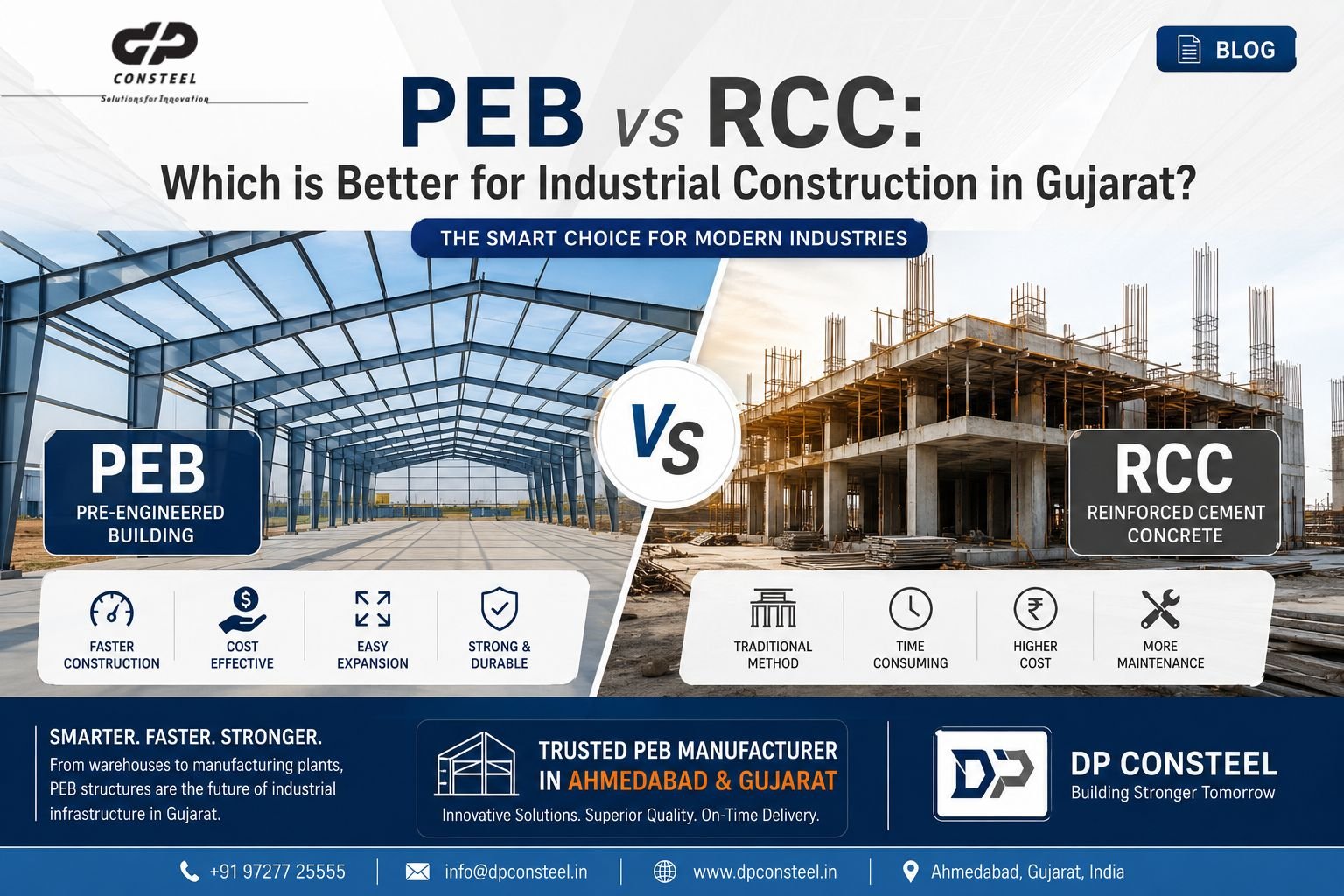
PEB vs RCC: Key Differences for Ahmedabad Industrial Buildings
PEB vs RCC: Which is Better for Industrial Construction in Gujarat?
The Smart Choice for Modern Factories, Warehouses, and Industrial Buildings
Industrial construction in Gujarat is evolving rapidly. From manufacturing plants and logistics hubs to warehouses and industrial sheds, businesses today need structures that are strong, cost-effective, and quick to build.
One of the biggest questions faced by industrial investors and business owners is:
Should you choose a PEB (Pre-Engineered Building) or an RCC (Reinforced Cement Concrete) structure?
The answer depends on your project goals, budget, timeline, and future expansion plans.
In this detailed guide, we will compare PEB and RCC structures, understand their key differences, and explain why most modern industries in Gujarat are moving towards Pre-Engineered Buildings.
If you are looking for a trusted PEB Manufacturer in Ahmedabad or a reliable PEB Manufacturer in Gujarat, this guide will help you make an informed decision.
What is a PEB (Pre-Engineered Building)?
A Pre-Engineered Building is a steel structure designed and manufactured in a factory before being transported to the construction site for assembly.
Unlike conventional construction, every component is engineered with precision using advanced software and manufacturing technology.
PEB structures are commonly used for:
-
Industrial sheds
-
Warehouses
-
Manufacturing plants
-
Logistics parks
-
Cold storage facilities
-
Commercial buildings
-
Aircraft hangars
-
Agricultural buildings
Today, PEB has become the preferred construction method for industries because of its speed, flexibility, and cost efficiency.
What is RCC Construction?
RCC stands for Reinforced Cement Concrete.
This traditional construction method uses cement, sand, aggregates, steel reinforcement, and water to build the structure directly on-site.
RCC structures are commonly used for:
-
Residential buildings
-
Apartments
-
Schools
-
Hospitals
-
Commercial complexes
While RCC remains suitable for many applications, industrial construction is increasingly shifting toward PEB due to several advantages.
PEB vs RCC: Major Differences
1. Construction Speed
PEB
All structural components are manufactured in the factory before arriving at the site.
This means:
-
Faster execution
-
Minimal site work
-
Reduced project delays
-
Better quality control
A typical industrial shed can often be completed within weeks.
RCC
RCC construction requires:
-
Excavation
-
Formwork
-
Reinforcement
-
Concrete casting
-
Curing
Each stage depends on the previous stage being completed.
As a result, RCC projects generally take much longer.
Winner: PEB
For industries where time equals money, PEB is the clear winner.
2. Cost Efficiency
Cost is one of the biggest reasons companies choose PEB.
PEB Advantages
-
Lower labour cost
-
Faster project completion
-
Reduced material wastage
-
Lower maintenance requirements
-
Future expansion without major reconstruction
RCC Challenges
-
Higher labour dependency
-
Longer project duration
-
Higher site management costs
-
Increased material wastage
For large industrial buildings, warehouses, and manufacturing facilities, PEB often proves to be more economical over the project's lifecycle.
Winner: PEB
3. Structural Weight
PEB structures are significantly lighter compared to RCC buildings.
Benefits include:
-
Reduced foundation cost
-
Easier transportation
-
Lower seismic load
-
Faster installation
RCC structures are heavier and require stronger foundations.
Winner: PEB
4. Future Expansion
Business growth is unpredictable.
A factory that requires 20,000 sq. ft. today may need 50,000 sq. ft. in the future.
PEB
Expansion is simple.
Additional bays and sections can be added with minimal disruption.
RCC
Expansion often requires demolition, redesign, and extensive structural modifications.
Winner: PEB
5. Earthquake Resistance
Gujarat lies in a region where earthquake-resistant construction is extremely important.
PEB structures are lighter and more flexible.
This flexibility allows them to absorb seismic forces more effectively.
RCC structures are rigid and heavier.
Winner: PEB
6. Large Clear Span Spaces
Industries need uninterrupted floor space.
PEB structures can easily provide:
-
Large column-free areas
-
Better machinery layout
-
Efficient warehouse operations
-
Improved logistics movement
RCC structures often require more columns.
Winner: PEB
7. Sustainability
Modern businesses are focusing on environmentally responsible construction.
PEB structures support sustainability because:
-
Steel is recyclable
-
Less construction waste is generated
-
Energy-efficient insulation systems can be installed
-
Lower environmental impact
This makes PEB an excellent choice for future-ready industrial infrastructure.
Winner: PEB
PEB vs RCC Comparison Table
| Parameter | PEB | RCC |
|---|---|---|
| Construction Speed | Very Fast | Slow |
| Cost Efficiency | High | Moderate |
| Future Expansion | Easy | Difficult |
| Structural Weight | Light | Heavy |
| Large Span Capability | Excellent | Limited |
| Earthquake Performance | Better | Moderate |
| Sustainability | High | Moderate |
| Maintenance | Low | Higher |
Why Industries in Gujarat Prefer PEB Structures
Gujarat is one of India's fastest-growing industrial states.
Cities like Ahmedabad, Sanand, Changodar, Bavla, Rajkot, Surat, Vadodara, and Bharuch are witnessing rapid industrial development.
Industrial investors are choosing PEB because:
Faster project completion
Lower investment risk
Higher operational efficiency
Better return on investment
Flexibility for future expansion
Whether it is an automobile plant, warehouse, pharmaceutical facility, engineering unit, or logistics hub, PEB has become the preferred construction solution.
Why Choose DP Consteel?
When it comes to selecting a trusted PEB Manufacturer in Ahmedabad, experience, manufacturing capability, and project execution matter.
DP Consteel has established itself as a trusted name in Gujarat's industrial construction sector by delivering high-quality Pre-Engineered Building solutions.
What Makes DP Consteel Different?
Advanced Manufacturing Facility
DP Consteel operates a modern manufacturing setup equipped with advanced machinery and engineering systems capable of handling large-scale industrial projects.
Industry Experience
Over the years, DP Consteel has successfully delivered solutions for:
Industrial sheds
Warehouses
Manufacturing plants
Commercial structures
Turnkey industrial projects
Customized Engineering
Every project is designed according to:
Industry requirements
Site conditions
Load calculations
Expansion possibilities
Focus on Innovation
DP Consteel continuously adopts modern engineering practices, advanced software, and innovative construction techniques to provide durable and cost-effective solutions.
End-to-End Project Execution
From design and engineering to manufacturing and erection, DP Consteel provides complete support under one roof.
The Future of Industrial Construction is PEB
Industrial construction is no longer just about building structures.
It is about:
Faster growth
Better efficiency
Lower costs
Sustainable development
PEB technology aligns perfectly with these goals.
As industries across Gujarat continue to expand, Pre-Engineered Buildings are becoming the foundation of modern industrial infrastructure.
Conclusion
When comparing PEB and RCC, the advantages of PEB are clear.
It offers:
Faster construction
Lower overall costs
Better flexibility
Easier expansion
Improved seismic performance
Greater sustainability
For industrial sheds, warehouses, factories, and logistics facilities, PEB is often the smarter long-term investment.
If you are planning an industrial project and looking for a reliable PEB Manufacturer in Ahmedabad or PEB Manufacturer in Gujarat, DP Consteel is ready to help you build stronger, faster, and smarter.
Contact DP Consteel today and take the first step toward future-ready industrial infrastructure.